Monday, September 26, 2016

Lingaraj Temple

Entrance to Lingaraj Temple
There are three iconic temples in Orissa, of which only two are still in worship. They are Lingaraj temple of Bhubaneswar built during the tenth century (in worship), Jagannath Temple of Puri built during the Eleventh century (in worship) and finally Sun Temple of Konark built during the 13th century. Sun temple is not in worship today and it is a declared World Heritage Site by UNESCO.

Group of shrines inside the compound

Lingaraj Temple is situated in the capital city of Bhubaneswar. It is one of India's most ancient temple and it is said that the first structure of this temple was built in 6th century! However major portion of this temple was completed during the last decade of the 10th century! 

The vast Bindu sagar lake is the centre around which there are many temples including Lingaraj Temple.

Experts say that this temple is a specimen of the Orissan temple in its final evolution.  Its tower with its tall spire standing out prominently  is 180 feet tall. There are a large number of shrines within its compound, built during different periods and they are in various shapes and sizes. Most prominent 
among them is the Bhagavati temple dedicated to the consort of Shiva.


They say by the time Lingaraj temple was built the statuary art had advanced in Orissa by strides. The statuettes on the Lingaraj are life like and gracefully enchanting. The scenes from the two Hindu epics are carved on the walls of the temple and they are remarkable for their detail. 

The outer walls of the main structure exhibit wonderful carvings. There are beautiful sculptures of Gods and Goddess besides various poses of man and women! 


This temple will be a BIG disappointment for people who love temple photography! Because Photography is completely banned in this temple. You are not allowed to even carry a camera, mobile phone and leather belt/bag inside the temple!  

But there is a way out! On the western side of the temple is Bhubaneswar Municipal Corporation's Hospital. I managed to take these pictures from the terrace of this hospital!


Thursday, May 5, 2016

Relief sculptures in Indian Temples

Stone art in India dates back to the era of Prehistoric art. Sculpture was the earliest artistic expression throughout the Indian subcontinent. Sculpture was mainly used as a form of religious art to illustrate the principles of Hinduism, Buddhism and Jainism. The origin of Plastic Art in India dates back to terracotta sculptures of Indus valley civilization and pioneering bronze sculptures of the Harappan Culture. Other important milestones in the  history of Indian sculpture include: the Buddhist Pillars of Ashoka of the Mauryan period; the figurative Greco-Buddhist sculpture of the Gandhara and Mathura schools, and the Hindu art of the Gupta period (1st-6th century CE). During the subsequent five centuries a wide range of sculptural forms flourished in India. The end of the most creative stage of Indian sculpture was reached with the erection of Khajuraho Temples in Madhya Pradesh by Chandela dynasty during the 10th/11th century. Most of the Indian sculptures were made by anonymous sculptors. This post will specifically attempt to discuss different types of Relief Sculptures found in the temples of the Indian subcontinent.
Example of a Relief sculpture
Relief is a sculptural technique where the sculptured elements remain attached to a solid background of the same material. The term relief is from the Latin verb relevo , to raise. What is actually performed when a relief is cut in from a flat surface of stone is a lowering of the field leaving the un-sculptured parts seemingly raised. This technique involves considerable chiselling away of the background which is a time consuming exercise. But the relief saves forming the rear of the subject, is less fragile and more securely fixed to its background than a sculpture in the round. 

There are different types of relief depending on the degree of projection of the sculptured form from the field. 

LOW OR BAS RELIEF
Low relief, also called as bas-relief  (pronounced "bah relief") is a projecting image with a shallow overall depth. This is a form of surface ornamentation in which the sculpted projection is very slight or shallow. The background is very compressed or completely flat on which images are typically sculptured. The term bas-relief is sometimes used in a general sense for all sculptured reliefs, as distinguished from free-standing sculpture in-the-round. Relief sculpture has proved to be especially adaptable for ornamental purposes in architecture, and for use as subordinate decoration in large sculptural works.
A dance troop of seven girls having only 6 pairs of legs! This amazing low relief sculpture is in Ramappa temple at Palampet village of Telangana
Bas relief on the pillars of Perur Pateeswarar temple, in Coimbatore Tamil Nadu. Built by Karkala Chozhan Circa 1300 CE
Amorous couples in 13th century Margabandeeswarar temple at Virinjeepuram in Tamil Nadu, India. Low relief.
HIGH RELIEF
High relief is one in which the forms and figures project out from the background to half or more than half of their natural depth. They are also called as alto-relievo.  Some parts in high relief may be completely disengaged from the platform thus approximating sculpture in the round.  High-relief uses essentially the same style and techniques as free-standing sculpture, and in the case of a single figure gives largely the same view as a person standing directly in front of a free-standing statue would have. Most of the large sculptures created in monuments and temple architecture in India have used this technique. Most of the grand figure reliefs in ancient Indian sculptures have used a very "high" version of high-relief, with elements often fully free of the background, and parts of figures crossing over each other to indicate depth. 

11th century High relief  depicting a Kamasutra position in Kandariya Mahadeva temple, Khajuraho, Madhya Pradesh, India.
Goddess Durga on the wall of Durga Temple in Aihole, Karnataka This high relief was Built by Chalukyan Dynasty between 7th and 8th century
High relief of Dancing shiva in Kailasanathar temple Kancheepuram, Tamil Nadu. This temple is the oldest structure in Kancheepuram and it was built between 685-705 CE by a Rajasimha ruler of the Pallava Dynasty
High relief has remained the dominant form for reliefs in Indian temple sculpture. Most of the Buddhist sculptures in India are high relief sculptures. They have used the main platform for aura or halo in the back of the sculpture's head or for floral decoration. A very good example of high version of High relief in Indian temple architecture is Khjuraho temple. Here one can see many sculptures displaying voluptuous twisting figures often described as the erotic kamasutra positions. 

SUNK OR SUNKEN RELIEF
Sunk or sunken relief is one in which the image is made by cutting the relief sculpture itself into a flat surface. In most cases the figure itself is in low relief, but set within a sunken area shaped round the image, This method minimizes the work of removing the background, while allowing normal relief modelling.. The technique is most successful with strong sunlight to emphasize the outlines and forms by shadow, as no attempt was made to soften the edge of the sunken area, leaving a face at a right-angle to the surface all around it.
Panel containing sunk relief of  undifferentiated Jain saviors in cave number 4 at Badami, Karnataka, India. These were carved in the later part of 6th century
6th Century Sunk relief  on the pillar depicting Vamana Avtar of Vishnu in Sangameswarar Temple of Alampur, Andhra Pradesh.
Sunken relief found in 12th century Darasuram Airavatesvara Temple at Darasuram, Tamil Nadu, India This is a UNESCO World Heritage Site
ROCK RELIEFS
Rock reliefs are those carved into solid rock in the open air. If the reliefs are inside a cave, whether natural or manmade they are called as Rock-Cut relief.  This kind of reliefs are more often used by Buddhist sculptures!
Jain Tirthankara rock relief, most amazing colossal structure of Gwalior, Madhya Pradesh, India Circa 1445 CE
Arjuna's penance or Descent of the Ganges, carved in the mid 7th century is the world's largest preserved open air rock relief - 29 meters long and 13 meters high.
Multi-armed dancing Shiva flanked by Nandhi on one side and Ganesh and drummers on the other side. This rock relief  is outside cave number one in Badami and belongs to 575 to 585 CE
Mahishasur Mardini in Ravanaphadi of Aihole, Karnataka, India 7th Century Rock cut relief
7th century rock cut relief of Krishna lifting Govardhan Hill in the Krishna Cave of Mahaballipuram, Tamil Nadu, India Part of UNESCO World Heritage Site
Rock cut relief of Vishnu's Varaha (boar) incarnation rescuing the goddess of earth Bhu Devi. 6th century


Tuesday, February 23, 2016

Brahma in Shiva temple

Pullamangai temple is located on the outskirts of Pashupathikoil, between Tanjavoor and Kumbakonam of Tamil Nadu. This temple is very deceptive to look at from outside but once you are inside this temple, you will discover its extraordinary grandeur! It was built during the early years of Chola King Parantaka Choladeva-1. Hence this temple existed with active worship during the early 7th century CE. 


People refer to this temple by various names - Thiruvalanthurai Mahadevar Temple, Sri Brahmapurisvara Temple, or Tiruppullamangai Temple!


The presiding deity of Pullamangai is  Brahmapuriswara - a form of Lord Shiva. This temple is often cited as Brahma Temple because of the sculptures on the exterior walls include a number of beautiful images of Brahma. 


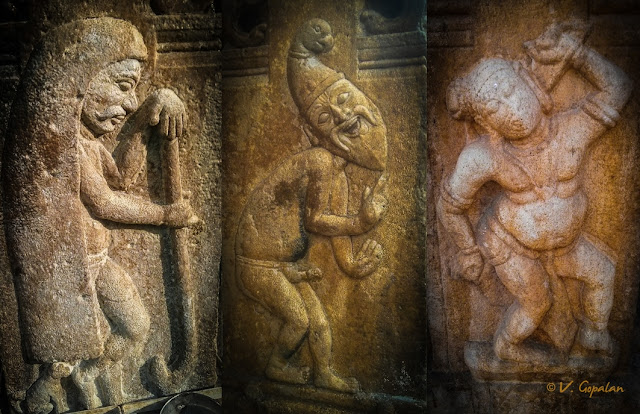
There are a number of extraordinary sculptures in this temple! Of the hundreds of sculptures seen in this temple the most adorable ones are Shiva's Ganas! These Ganas are depicted in different happy moods and dancing poses!


The Lingobhava murti seen here are very similar to the ones seen in Big temple of Tanjavoor and Gangaikonda Chozhapuram.


Monday, February 22, 2016

Sixth Century Shiva Temple


Mahakuta is a tiny village in Karnataka. The main attraction of this place is a Sixth Century CE group of temples. This is a place of religious significance for Shaivites. It is situated in Bagalkot District of Karnataka, a few kilometres away from Badami.


These temple's architecture is a hybrid of Dravidian and Nagara style and they also resemble northern and southern styles. Probably the architects of those times were experimenting on different styles.

At the centre of these temples there is a spring fed tank called Vishnu Pushkarni. A constant stream of water passes through this tank from a mountain spring. They also call it by another name Papavinasha Tirth meaning tank which purifies from sins. This tank has a rare statue of Lingam called Panchamukhi Shiva Linga - with five faces of Shiva. Since swimming is allowed in this tank, swimming here is the greatest past-time of boys who live around these temples.


The outer walls of the temple bear a number of pieces of art executed by sculptors of the Early Chalukyan times. Noteworthy among them are Ardhanareershwara, Varaha rescuing Prithvi, Lakulisha propounder of Yoga system and a few guardian deities. There are also pierced windows characteristic of the Chalukyan temples.


Monday, February 1, 2016

Durga Temple of Aihole, Karnataka


Aihole is historically famous as the cradle of Hindu temple architecture. There are about 125 temples divided into 22 groups scattered all over the villages and nearby fields. Most of these temples were built between the 6th & 8th centuries and some even earlier!


The main attraction at Aihole, Karnataka is the Durga Temple. This is not a temple of lord Durga but it derives its name from its vicinity to the fort (Durga). Originally it was a Surya temple, subsequently it is dedicated to either Vishnu or Shiva as the representations of Vishnu are as numerous as those of Shiva.


Durga temple is the most elaborately decorated monument in Aihole. The columns at the entrance and within the porch are carved with figures and ornamental relief's. This temple is considered a unique and magnificent temple of the Chalukyan period.


Sunday, January 24, 2016

© Copy right mark

Long time since I posted anything in my blog - 8 months to be specific! I almost lost interest in posting anything new! This is because I find very frequently guys stealing my pictures and using it elsewhere - even government agencies have done this shamelessly!


But now I have decided to restart posting in my blog! But with a difference. From today all my photographs in my blog will have a BIG copy right mark across the pictures! This will to some extent spoil the picture but I am forced to do so as it is hoped that no further stealing will be done!

Monday, May 25, 2015

Rat temple of Deshnok


There is a small town in Rajastan called Deshnok, which is 30 KM from Bikaner town.  This place is famous for something unusual – A rat temple!

There is a temple called Karni Mata Temple in this town. There are more than 20,000 rats in this temple. I have never seen so many rats in a single place in my life! Not even in the animal house of my college or in the R&D wing of my company! The temple is dedicated to Goddess Karni, who is regarded as the incarnation of Maa Durga.

I am posting  some of the pictures taken in this temple here: