Friday, August 3, 2012

Quli Qutub Shahi Tombs


If you want to see the most authentic and majestic display of the Qutub Shahi dynasty’s architectural traditions then the city you should be heading to is Hyderabad, India!


Hyderabad was ruled by seven Kutub Shahi rulers from Golconda for nearly 170 years. Naturally we can find lot of their foot prints in the city of Hyderabad. One of the magnificent structures is Tombs of Qutub Shahi dynasty on the outskirts of the city. So many beautiful tombs in one place! Probably one cannot see a cluster of beautiful tombs like this anywhere in India. Orcha of Madhya Pradesh might be an exception where one can see a collection of Cenotaphs on the banks of the river Betwa. 


Right opposite to the tomb of Haiat Bakshy Begum there is a very small masjid. Aurangazeb, the mogul emperor is believed to have offered prayers at this small mosque during his siege of Golconda in 1867. Historians are of the opinion that this mosque might have been selected by Aurangazeb due to his reverence for the great Lady Hayat Bakshi Begum, who led a peace mission during Aurangazeb’s first siege of Golconda in 1655 when he was only a prince. 


All over Hyderabad these rulers have built many masjids. The most beautiful and the grandest of such masjids is besides the mausoleum of Haiat Bakshy Begum Wife of Sultan Mohamed Qutub  Shah the fifth ruler of Golconda. This is popularly known as the Great Masjid. This was built in the year 1666 AD. 


The tombs differ in size but all are comparable to each other in architectural grandeur and beauty. Ironically, one of the most modest of these tombs belongs to the Qutub Shahi dynasty founder, Sultan Quli Qutub-ul-Mulk. He built his tomb himself and it is just marked by simplicity and design symmetry, standing on a platform 30 meters on each side.


The most impressive is the tomb of Hyderabad’s founder, Muhammed Quli Qutub Shah. It is 42.5 meters tall and topped by a large dome. The tomb was constructed on a two-tiered terrace designed to look like a captivating gallery, complete with false openings and two central pillars. Minarets and rich ornamental parapets complete the Islamic architecture. The Cenotaph of Muhammed Quli Qutub Shah is on the first floor while his body is actually buried in the ground floor!

 
The seventh tomb lies unfinished as the 7th Nawab Abdul Hassan was taken captive by Aurangazeb even before he could finish the construction!


Before the burial the dead are given a final bath in this place. Provision for both hot and cold water is available here.


In my opinion, this should be one of the most beautiful burial grounds found in India!

Wednesday, June 27, 2012

An exceptional event!


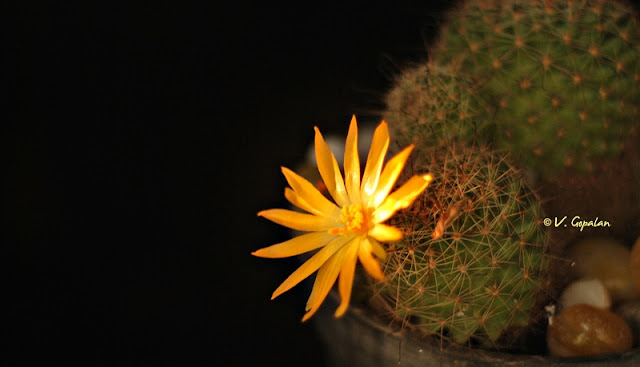
I have always been amazed at the beauty and diversity of cactus flowers.  May be they have to cry out louder for pollinating insects than other flowers in wetter places.

Till recently I have never seen a live cactus flower.
All I have seen is only in pictures!!

Last week I got up in the morning and went to my balcony to water my rose plants. I do this meticulously everyday now, because summer heat in Hyderabad is around 42 degrees Celsius. I accidentally noticed a beautiful yellow flower in one of my cactuses. I have been having this cactus for more than 8 years now and I have never seen it flowering and for that matter I did not know that this guy is capable of flowering!

This, certainly, was a very pleasant surprise!

I have posted below some of the shots which I took of my cactus plant.


Tuesday, June 12, 2012

Dharasuram


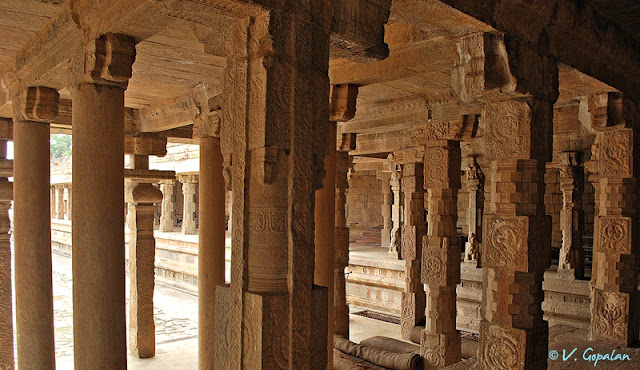
Dharasuram is a tiny village located 4 km west of Kumbakonam, in the southern state of Tamil Nadu, India. The main attraction of this village is an ancient temple built by the Chola King, Rajaraja II. This temple is dedicated to lord Shiva and is called Airavateshwarar temple.


This temple is a storehouse of art and architecture. The vimana is 85 feet high. The front mandapam itself is in the form of a huge chariot drawn by horses. The temple has some exquisite stone carvings.


Darasuram temple was built by the Cholas between the 10th and 12th centuries CE and has a lot of similarities with that of Big temple of Tanjavur which was also built by the same king.


The main deity's consort Periya Nayaki Amman temple is situated adjacent to Airavateshwarar temple. The temple is a recognised UNESCO World Heritage monument.


Thursday, March 1, 2012

Dhokra


Dhokra is a traditional handicraft of Odisha (Orissa) a state in the eastern side of India. This is a typical tribal craft in bronze with its mesh like features giving it a distinctive beauty. The tribal families of Sadeibareni, a village near Dhenkanal town produces this very unusual craft. There are many types of handicrafts in the state of Odisha and generally these people are very artistic. The Sun temple at Konark is a standing testimony to this.


The BELL METAL or DHOKRA is one of the earliest known methods of metal casting. This craft dates back to pre-historic time of Harrappa and Mohenjodaro period of Indus Civilization. The beauty of this art is that it is still done by hand without any advancement of technology!

Dhokra metal casting is perhaps the only living tradition of metal image making in Eastern India. The technique has managed to survive many centuries and change of dynasties owing to its modesty of application in everyday lives.


The Dhokra castings of figurines and different animals with their antique look, fits in with interior decor. Dhokra is an alloy of brass, nickel and zinc that gives an antique effect of the castings.

Earlier craftsmen used to create only traditional ritualistic items and decorative pieces but now with new designs inputs, there has been a lot of product diversification, resulting in numerous innovative utility items like door handles, lamp shades, hangers, boxes and caskets of different shapes and sizes. More than 10,000 unique old tradition and new design products are available right now and it is continuously increasing.

Monday, February 27, 2012

Mamallapuram


Mamallapuram or recently called as Mahabalipuram is near Chennai, formerly Madras (names are pretty frequently changed I guess!). This place is one of the UNESCO's World Heritage sites.  There are five temples in Mahabalipuram all of them are monoliths. 

Believed to be built 2000 years ago (7th century), many monuments are lying unfinished here even today! The main attraction here are the Rock cut cave temples called mandapas, monolithic shrines – rathas, sculptured relief rock panels and the famous shore temple. These structures were built by three successive Pallava kings who developed the Dravidian style of temple architecture within a span of a hundred years. 

I visited this picture in January this here and some of the pictures of Mamallapuram are published here:


Friday, February 24, 2012

Ten photographs


I regularly share my photographs in a Dutch web site - World of Photography – www.woophy.com

In this post I am posting Top ten pictures I like the most in no particular order from this site. I have also given the name of the photographer and each picture is linked to its original place in the site.Here they are:
 
The first one was taken by Lucija Mujanovic from Bosnia. 

 
The second one was taken by Kambrosis Buenos Aires, Argentina.


The third picture was taken by SteveFitz, Christchurch, New Zealand.


The fourth picture was taken by  Tigreramon, Tokyo, Japan.


The following one was taken by  İlker Güneysu, Balikesir, Turkey.


The next picture is from India taken by  Deevus, Tauranga, New Zealand 


 Laura C, of Solna, Sweden took the following picture.


Paul Leger, of Bordeaux, France is the photographer of the following picture.


The next one is from Phillipines - eslwinshot San Carlos, Philippines.


 The final one is from Morocco. The photographer is Jacques Splint
from The Netherlands. 


Thursday, February 16, 2012

H O O K A H


A hookah also known as a waterpipe is a single or multi-stemmed instrument for smoking flavoured tobacco in which the smoke is passed through a water basin (often glass based) before inhalation. The Origin of the hookah is traced to India and Persia. In the earlier days Indians used to call this as “huqqa” which later on became ‘Hookah’. According to some authors it was Abul-Fath Gilani a Persian physician at the Indian court of the Mughal emperor Akbar, who “first passed the smoke of tobacco through a small bowl of water to purify and cool the smoke and thus invented the hubble-bubble or hookah.” 
 
Smoking the hookah gained popularity outside of its native region, in India and the Middle East, and is gained popularity in North America, South America, Europe, Australia and South Africa. They believed that passing the smoke of the tobacco through water ‘purifies’ the smoke! Subsequently the moguls added flavors to the water and when the smoke is passed through the flavored water the smoke also became flavored! Smoking hookah was very common among mogul culture.

Of late smoking hookah is catching on among youngsters and many Hookah cafes and bars have sprung up in the Indian metros. There is a general belief that smoking hookah is less harmful to health compared to cigarette smoking.  Recent studies comparing the ill effects of cigarette smoking and hookah smoking say that smoking hookah in no way better than cigarette smoking.

The tobacco is no less toxic in a hookah pipe, and the water in the hookah does not filter out the toxic ingredients in the tobacco smoke. Hookah smokers may actually inhale more tobacco smoke than cigarette smokers do because of the large volume of smoke they inhale in one smoking session, which can last as long as 60 minutes

While research about hookah smoking is still emerging, evidence shows that it poses many dangers:
  • Hookah smoke contains high levels of toxic compounds, including tar, carbon monoxide, heavy metals and cancer-causing chemicals (carcinogens). In fact, hookah smokers are exposed to more carbon monoxide and smoke than are cigarette smokers.
  • As with cigarette smoking, hookah smoking is linked to lung and oral cancers, heart disease and other serious illnesses.
  • Hookah smoking delivers about the same amount of nicotine as cigarette smoking does, possibly leading to tobacco dependence.
  • Hookah smoke poses dangers associated with secondhand smoke.
  • Hookah smoking by pregnant women can result in low birth weight babies.
  • Hookah pipes used in hookah bars and cafes may not be cleaned properly, risking the spread of infectious diseases.


According to CDC (Centers for Disease control and Prevention), while many hookah smokers may consider this practice less harmful than smoking cigarettes, hookah smoking carries many of the same health risks as cigarettes. Hookah smoking is NOT a safe alternative to smoking cigarettes.

There are lot of myths about Hookah smoking - like,

Myth #1: “Smoking water pipe tobacco is good for you because it has fruit in it”
Myth #2: “It makes me feel relaxed”
Myth #3: “At least, I’m not smoking cigarettes”
Myth #4: “The water filters the smoke and takes out all harmful chemicals”
Myth #5: “I’m not smoking the entire time, I’m sharing it with my friends”

Unfortunately, believing these myths has only added to the appeal of hookah smoking as a trendy popular social activity. As with any decision we make concerning our health, it is important to be informed of the risks and benefits to our body.