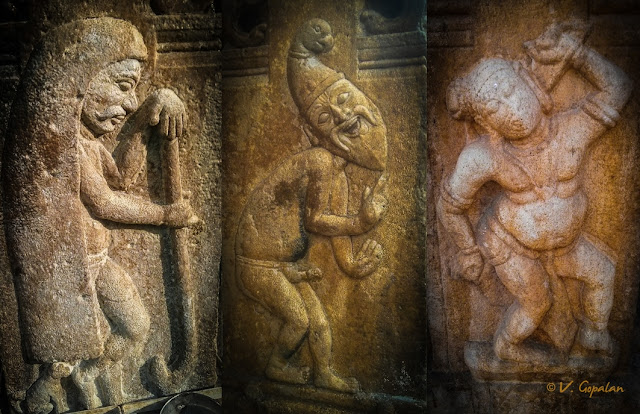
Thursday, October 6, 2016

Vaital Temple Bhubaneshwar


This interesting 8th century temple is dedicated to Chamunda (A form of Kali) and it is one of the oldest temples of Odisha. It also assumes greater significance as it is a rare temple in the country because this temple is used as a shrine devoted to Tantric cult! 


It is said that Vaital Temple is an excellent example of Kalinga architecture. It is a representative of the Khakhara order that was specially devoted to Tantric cults. The entire temple is an exhibition of the finest skill of Orriyan artisans. Some of the sculptures are so fantastic that they almost look like 
living human beings. Each sculpture is decorated with detailed ornaments. The extent to which those unknown sculptures have given importance to the finest detail is simply amazing!  This is one of the finest temples I have visited in India.


This great architectural wonder is on the brink of collapse any time soon, if proper action is not taken by the concerned authorities immediately! Monsoon is the biggest threat to this temple next to indiscriminate encroachment from the neighbourhood. 

Every monsoon this temple gets inundated with rain waters. The temple is below the road level and the main road is practically touching the temple. Hence even with a few millimetres of rain, the rain water from the road gets into the temple and fills the entire floor of the temple including the sanctum sanctorum!  Even the priests can't wade through the waist-deep water to perform the daily rituals during such water logging! Archeological Survey of India has installed a pump to drain the water as a temporary measure. But the problem with this is that the vibrations from the pump is affecting the 1300 years old structure and it may weaken the temple's foundation! 


BDA's (Bhubaneswar Development Authority) Indiscriminate approvals for buildings around this temple and thoughtless planning of the drainage system are responsible for the tragic state of this temple today. ASI is actually helpless in this cases. It seems that the local media have been highlighting this problem for years but sadly no one in the Orissa Government seems to be bothered about this.

The way houses have come up surrounding this temple speaks volumes about the concern the local government is having for these monuments. Houses have come up surrounding this temple encroaching on the drainage channel originating from the temple completely violating the Ancient Monuments and Archaeological Sites and Remains Act, 1958. Few years from now it will not be a surprise if this temple vanishes completely! 


Take a look at the pictures in this post. You can observe the encroachments and what a great monument that is left uncared by the government. 

Very S A D!

Sunday, October 2, 2016

Most abused temple of Orissa!


On the eastern banks of the ancient Bindu Sarobar Lake stands a magnificent 13th century temple called Anantha Basudev Temple.  This is the only Vaishnavite temple which is intact today relatively!) and is still in worship in Bhubaneswar. It is under the Archeological Survey of India and according to them it was built during the 13th century, by  Queen Chandrika of Eastern Ganga dynasty. Later in 17th century when Maratha empire extended up to Mahanadhi they renovated this temple extensively. So this temple is more than 900 years old!


There are four stages in this temple and they are: Bhog Mandap (place where Bhog is distributed), Nat Mandir (Dance Area), Jogmohan (assembly area) and the Biman, housing the Garbha Griha (inner sanctum). It is a classic example of Orissa Temple Architecture.

The inner and outer walls of the temple are carved  with many intricate designs similar to other temples of Orissa. There are many sculptures of female figures. These sculptures are heavily decorated with ornaments. Large varieties of figures are carved on the outer walls with minute details and decorations.


Today this temple must be the most abused temple in India! Unfortunately this magnificent temple is poorly maintained as dozen of priests are busy cooking the bhog (Prasad) at the temple complex itself. In fact the entire outer courtyard of the temple is now used as kitchen for the priests and devotees to cook Mahaprasad. The soot emanating from the firewood has blackened major portion of the yellow sand stones and most of the beautiful sculptures are severely damaged.

Because of the rift between the Bhubaneswar Municipal Corporation and the temple authorities the new kitchen outside the temple complex is not yet built although the required land has been procured two decades back! It seems quite frequently fire breaks out in these kitchens and every time fire breaks out, heat from the fire damages the temple beyond repair! A major fire broke out in September of 2010 and damaged the temple structure  extensively. Though catching fire has become a regular menace in this temple, there has been no initiative from the authorities to replace the hay of the roof of the kitchen with concrete!!


The Archaeological Survey of India (ASI) had identified thie temple as one of the oldest heritage monuments of the east. In spite of this no one seems to be bothered to preserve this monument including the Orissa State Government!

This great monument has become the victim of apathy of the state government and inability of ASI to resolve the local issues! 

The best joke is - there is a board at the entrance of this temple which says "Protected Monument" !!!!! From what? - I do not know!


Monday, September 26, 2016

Vishwa Shanti Stupa


Eight KMs from Bhubaneswar, the capital city of Orissa, on the banks of the river Daya is located a small hill called Dhauligiri. It is also known locally as Dhauli. On the way to the hill summit one can notice splendid edicts of Ashoka embossed on a mass of rock. 


It is believed that Dhauli was the battlefield of the famous Kalinga War, in which the Mauryan emperor Ashoka won the battle in 265 BC. It is said that as a result of Kalinga War Daya river turned red by the blood of the dead bodies of the soldiers thrown all around the river bank. Although he won the battle the horrors of having killed over 150,000 people and the misery it inflicted on the people, filled Ashoka with remorse and brought about a sudden change of heart in him. He gave up his ambition of military conquest in favour of spiritual conquest!


The great Mauryan king renounced the path of violence to embrace Buddhism and publicized his new maxims in rock edicts and installed them in different parts of his empire. One of these is here at the base of Dhauli hills, in which he proclaims, 'All men are my children', and expresses his concern to ensure impartiality, non-violence, justice and compassion!


Today the more visited site is, Vishwa Shanti Stupa at the top of Dhauli Hill, built by Indo Japanese collaboration in 1972, standing in the form of a massive dome with lotus petals as its crown. This gleaming white double story structure stands on a platform with two entrances with flights of steps. The stupa, from its origin emerges as the central focus of worship.


Lingaraj Temple

Entrance to Lingaraj Temple
There are three iconic temples in Orissa, of which only two are still in worship. They are Lingaraj temple of Bhubaneswar built during the tenth century (in worship), Jagannath Temple of Puri built during the Eleventh century (in worship) and finally Sun Temple of Konark built during the 13th century. Sun temple is not in worship today and it is a declared World Heritage Site by UNESCO.

Group of shrines inside the compound

Lingaraj Temple is situated in the capital city of Bhubaneswar. It is one of India's most ancient temple and it is said that the first structure of this temple was built in 6th century! However major portion of this temple was completed during the last decade of the 10th century! 

The vast Bindu sagar lake is the centre around which there are many temples including Lingaraj Temple.

Experts say that this temple is a specimen of the Orissan temple in its final evolution.  Its tower with its tall spire standing out prominently  is 180 feet tall. There are a large number of shrines within its compound, built during different periods and they are in various shapes and sizes. Most prominent 
among them is the Bhagavati temple dedicated to the consort of Shiva.


They say by the time Lingaraj temple was built the statuary art had advanced in Orissa by strides. The statuettes on the Lingaraj are life like and gracefully enchanting. The scenes from the two Hindu epics are carved on the walls of the temple and they are remarkable for their detail. 

The outer walls of the main structure exhibit wonderful carvings. There are beautiful sculptures of Gods and Goddess besides various poses of man and women! 


This temple will be a BIG disappointment for people who love temple photography! Because Photography is completely banned in this temple. You are not allowed to even carry a camera, mobile phone and leather belt/bag inside the temple!  

But there is a way out! On the western side of the temple is Bhubaneswar Municipal Corporation's Hospital. I managed to take these pictures from the terrace of this hospital!


Thursday, May 5, 2016

Relief sculptures in Indian Temples

Stone art in India dates back to the era of Prehistoric art. Sculpture was the earliest artistic expression throughout the Indian subcontinent. Sculpture was mainly used as a form of religious art to illustrate the principles of Hinduism, Buddhism and Jainism. The origin of Plastic Art in India dates back to terracotta sculptures of Indus valley civilization and pioneering bronze sculptures of the Harappan Culture. Other important milestones in the  history of Indian sculpture include: the Buddhist Pillars of Ashoka of the Mauryan period; the figurative Greco-Buddhist sculpture of the Gandhara and Mathura schools, and the Hindu art of the Gupta period (1st-6th century CE). During the subsequent five centuries a wide range of sculptural forms flourished in India. The end of the most creative stage of Indian sculpture was reached with the erection of Khajuraho Temples in Madhya Pradesh by Chandela dynasty during the 10th/11th century. Most of the Indian sculptures were made by anonymous sculptors. This post will specifically attempt to discuss different types of Relief Sculptures found in the temples of the Indian subcontinent.
Example of a Relief sculpture
Relief is a sculptural technique where the sculptured elements remain attached to a solid background of the same material. The term relief is from the Latin verb relevo , to raise. What is actually performed when a relief is cut in from a flat surface of stone is a lowering of the field leaving the un-sculptured parts seemingly raised. This technique involves considerable chiselling away of the background which is a time consuming exercise. But the relief saves forming the rear of the subject, is less fragile and more securely fixed to its background than a sculpture in the round. 

There are different types of relief depending on the degree of projection of the sculptured form from the field. 

LOW OR BAS RELIEF
Low relief, also called as bas-relief  (pronounced "bah relief") is a projecting image with a shallow overall depth. This is a form of surface ornamentation in which the sculpted projection is very slight or shallow. The background is very compressed or completely flat on which images are typically sculptured. The term bas-relief is sometimes used in a general sense for all sculptured reliefs, as distinguished from free-standing sculpture in-the-round. Relief sculpture has proved to be especially adaptable for ornamental purposes in architecture, and for use as subordinate decoration in large sculptural works.
A dance troop of seven girls having only 6 pairs of legs! This amazing low relief sculpture is in Ramappa temple at Palampet village of Telangana
Bas relief on the pillars of Perur Pateeswarar temple, in Coimbatore Tamil Nadu. Built by Karkala Chozhan Circa 1300 CE
Amorous couples in 13th century Margabandeeswarar temple at Virinjeepuram in Tamil Nadu, India. Low relief.
HIGH RELIEF
High relief is one in which the forms and figures project out from the background to half or more than half of their natural depth. They are also called as alto-relievo.  Some parts in high relief may be completely disengaged from the platform thus approximating sculpture in the round.  High-relief uses essentially the same style and techniques as free-standing sculpture, and in the case of a single figure gives largely the same view as a person standing directly in front of a free-standing statue would have. Most of the large sculptures created in monuments and temple architecture in India have used this technique. Most of the grand figure reliefs in ancient Indian sculptures have used a very "high" version of high-relief, with elements often fully free of the background, and parts of figures crossing over each other to indicate depth. 

11th century High relief  depicting a Kamasutra position in Kandariya Mahadeva temple, Khajuraho, Madhya Pradesh, India.
Goddess Durga on the wall of Durga Temple in Aihole, Karnataka This high relief was Built by Chalukyan Dynasty between 7th and 8th century
High relief of Dancing shiva in Kailasanathar temple Kancheepuram, Tamil Nadu. This temple is the oldest structure in Kancheepuram and it was built between 685-705 CE by a Rajasimha ruler of the Pallava Dynasty
High relief has remained the dominant form for reliefs in Indian temple sculpture. Most of the Buddhist sculptures in India are high relief sculptures. They have used the main platform for aura or halo in the back of the sculpture's head or for floral decoration. A very good example of high version of High relief in Indian temple architecture is Khjuraho temple. Here one can see many sculptures displaying voluptuous twisting figures often described as the erotic kamasutra positions. 

SUNK OR SUNKEN RELIEF
Sunk or sunken relief is one in which the image is made by cutting the relief sculpture itself into a flat surface. In most cases the figure itself is in low relief, but set within a sunken area shaped round the image, This method minimizes the work of removing the background, while allowing normal relief modelling.. The technique is most successful with strong sunlight to emphasize the outlines and forms by shadow, as no attempt was made to soften the edge of the sunken area, leaving a face at a right-angle to the surface all around it.
Panel containing sunk relief of  undifferentiated Jain saviors in cave number 4 at Badami, Karnataka, India. These were carved in the later part of 6th century
6th Century Sunk relief  on the pillar depicting Vamana Avtar of Vishnu in Sangameswarar Temple of Alampur, Andhra Pradesh.
Sunken relief found in 12th century Darasuram Airavatesvara Temple at Darasuram, Tamil Nadu, India This is a UNESCO World Heritage Site
ROCK RELIEFS
Rock reliefs are those carved into solid rock in the open air. If the reliefs are inside a cave, whether natural or manmade they are called as Rock-Cut relief.  This kind of reliefs are more often used by Buddhist sculptures!
Jain Tirthankara rock relief, most amazing colossal structure of Gwalior, Madhya Pradesh, India Circa 1445 CE
Arjuna's penance or Descent of the Ganges, carved in the mid 7th century is the world's largest preserved open air rock relief - 29 meters long and 13 meters high.
Multi-armed dancing Shiva flanked by Nandhi on one side and Ganesh and drummers on the other side. This rock relief  is outside cave number one in Badami and belongs to 575 to 585 CE
Mahishasur Mardini in Ravanaphadi of Aihole, Karnataka, India 7th Century Rock cut relief
7th century rock cut relief of Krishna lifting Govardhan Hill in the Krishna Cave of Mahaballipuram, Tamil Nadu, India Part of UNESCO World Heritage Site
Rock cut relief of Vishnu's Varaha (boar) incarnation rescuing the goddess of earth Bhu Devi. 6th century